When it comes to PTI labeling, there’s a common assumption that thermal transfer is the better choice. In some applications, it absolutely is. But in many produce applications, I’ve found that assumption can lead customers to spend money on something they simply don’t need.
The key question is: What is the label actually going to be exposed to?
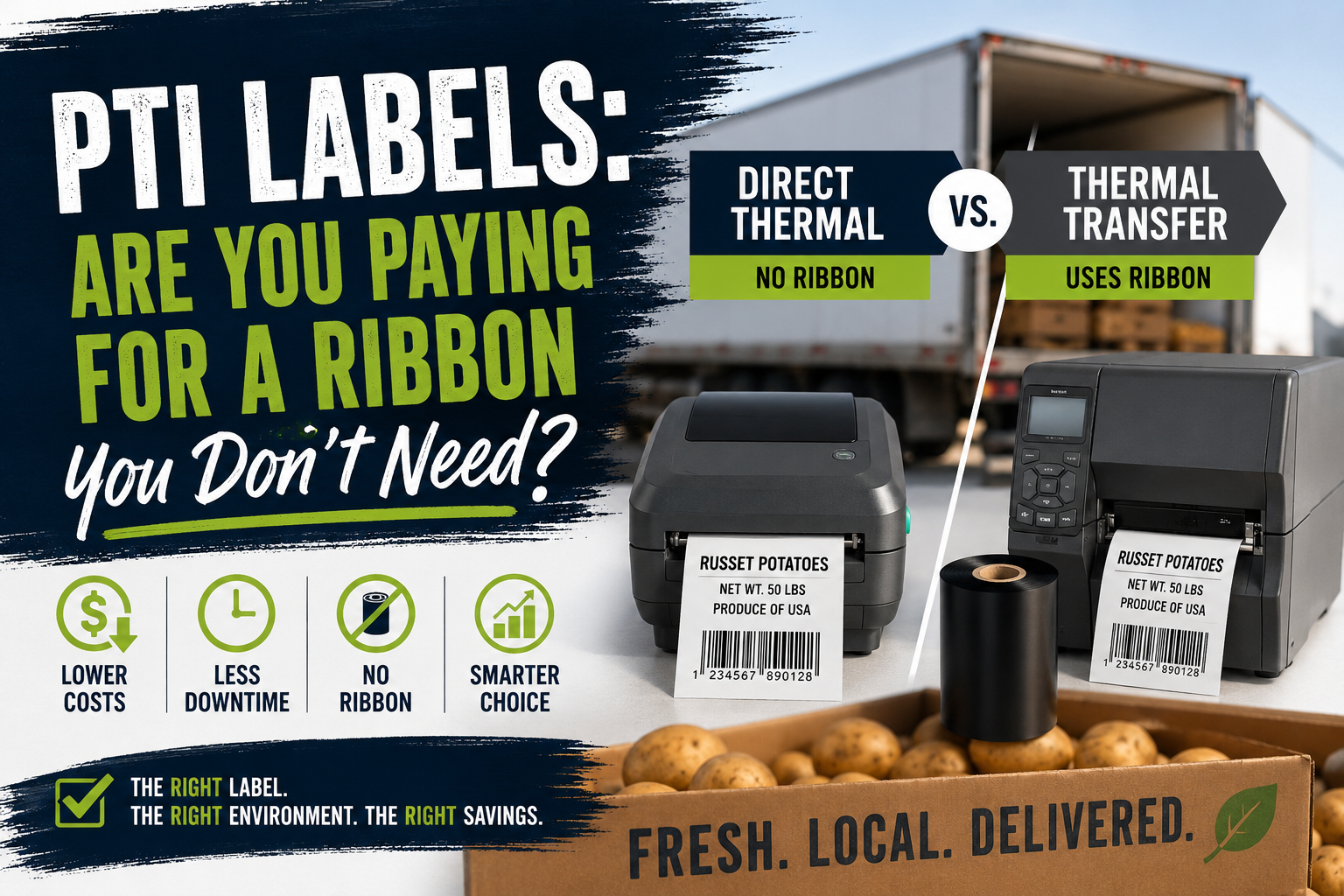
Direct Thermal vs. Thermal Transfer
The difference is fairly straightforward.
Thermal transfer labels use a ribbon to transfer ink onto the label. The advantage is durability. They’re a good choice when the label needs to withstand conditions such as prolonged exposure to direct sunlight, heat, moisture, chemicals, or other harsh environments.
Direct thermal labels don’t require a ribbon. The label stock itself is heat-sensitive, so the printer creates the image directly on the label.
That means one less consumable, less maintenance, and a significantly lower operating cost.
And that’s where I think the produce industry needs to take a closer look at its PTI labeling applications.
What Happens After the Produce Leaves Your Facility?
Most fresh produce isn’t sitting outside in direct sunlight for weeks at a time.
In many cases, produce is shipped from the back door of a facility directly into a controlled, enclosed trailer. From there, it continues through a controlled supply chain to the customer.
If the PTI label is spending its life inside a trailer, warehouse, distribution center, or grocery store, does it really need the added durability and cost of a thermal transfer ribbon?
In many cases, no.
I’ve switched numerous customers from thermal transfer to direct thermal for this exact reason. The results have been very good.
Eliminating the Ribbon Can Make a Real Difference
One of the biggest advantages is obvious: you eliminate the ribbon.
That means you’re not purchasing, stocking, changing, and disposing of ribbons. You also eliminate the downtime and hassle associated with ribbon changes.
When you’re running high volumes of produce, those costs add up.
Direct thermal can provide a very effective PTI labeling solution at a fraction of the cost of a thermal transfer application—provided the label is being used in the right environment.
That last part is important.
I’m not saying direct thermal is always the answer. If your labels are going to be exposed to prolonged direct sunlight or other conditions that can affect the image, thermal transfer may be the right technology.
But if your product is moving through a typical controlled, enclosed produce supply chain, it’s worth asking whether you’re paying for durability you don’t actually need.
The Right Label Depends on the Application
This is where experience matters.
There’s no reason to spend more simply because a particular technology is considered the industry standard. The right question is always: What does the application require?
If the answer is that the label needs to survive prolonged outdoor exposure, thermal transfer makes sense.
If the label is primarily moving through enclosed, controlled environments, direct thermal may be the smarter choice.
I’ve helped customers make this switch, eliminate the ribbon, simplify their operation, and reduce their labeling costs—and they’ve had great success with it.
Before you automatically specify thermal transfer for your next PTI labeling application, take a hard look at where that label is actually going to live. You may find that direct thermal does the job just as well, without the unnecessary expense.