---
title: "FIBC Bulk Bags for Coffee Beans: How Liners, Storage Conditions, and Handling Affect Quality"
description: "FIBC bulk bags for coffee beans: learn how liners, storage conditions, and handling impact moisture control, aroma retention, and product quality."
image: https://blog.nationalbulkbag.com/hubfs/FIBC%20Bulk%20Bags%20for%20Coffee%20Beans.png
---
Call Us Today! 1-888-237-4224|[info@nationalbulkbag.com](mailto:info@nationalbulkbag.com)
[](http://www.nationalbulkbag.com/)
- [HOME](https://www.nationalbulkbag.com/)
- [BULK BAGS](https://www.nationalbulkbag.com/fibc-bulk-bags/)
- [In-Stock Bulk Bags](https://www.nationalbulkbag.com/fibc-bulk-bags/)
- [Duffle Top Bulk Bags](https://www.nationalbulkbag.com/fibc-bulk-bags/duffle-top-bulk-bags/)
- [Spout Top Bulk Bags](https://www.nationalbulkbag.com/fibc-bulk-bags/spout-top-bulk-bags/)
- [Bulk Bags with Baffles](https://www.nationalbulkbag.com/fibc-bulk-bags/bulk-bags-baffles/)
- [Vented Bulk Bags](https://www.nationalbulkbag.com/fibc-bulk-bags/vented-bulk-bags/)
- [Food Grade Bulk Bags](https://www.nationalbulkbag.com/fibc/in-stock-food-grade-bulk-bags/)
- [Bulk Bags with Liners](https://www.nationalbulkbag.com/fibc/bulk-bags-liners/)
- [Bulk Bag Poly Liners](https://www.nationalbulkbag.com/products/bulk-bag-liners/bulk-bag-liners/)
- [Hemp Bulk Bags](https://www.nationalbulkbag.com/hemp-fibc-bulk-bags/)
- [Bulk Bag Filling Equipment](https://www.nationalbulkbag.com/products/bulk-bag-filling-equipment/ibc3000-fibc-bulk-bag-filler/)
- [FOOD GRADE FIBCS](https://www.nationalbulkbag.com/food-grade-bulk-bags/)
- [PRODUCE PACKAGING](https://www.nationalbulkbag.com/produce-packaging/)
- [Produce Packaging](https://www.nationalbulkbag.com/produce-packaging/)
- [Mesh Produce Bags](https://www.nationalbulkbag.com/produce-packaging/mesh-produce-bag/)
- [Potato Bags](https://www.nationalbulkbag.com/produce-packaging/potato-bag/)
- [Burlap Bags](https://www.nationalbulkbag.com/produce-packaging/burlap-bags/)
- [Custom Poly Bags](https://www.nationalbulkbag.com/produce-packaging/custom-poly-bags/)
- [Woven Polypropylene Bags](https://www.nationalbulkbag.com/produce-packaging/woven-polypropylene-bags/)
- [Netting Bags](https://www.nationalbulkbag.com/produce-packaging/netting-bags/)
- [V-board](https://www.nationalbulkbag.com/produce-packaging/gaylord-box/vboard/)
- [Gaylord Boxes](https://www.nationalbulkbag.com/produce-packaging/gaylord-box/)
- [BUYER TOOLS](https://www.nationalbulkbag.com/national-bulk-bag-resources/)
- [Blog](https://blog.nationalbulkbag.com)
- [Bulk Bags](https://blog.nationalbulkbag.com/topic/bulk-bags)
- [Food Grade Bulk Bags](https://blog.nationalbulkbag.com/topic/food-grade-bulk-bags)
- [Bulk Bag Safety](https://blog.nationalbulkbag.com/topic/bulk-bag-safety)
- [Bulk Bag Liners](https://blog.nationalbulkbag.com/topic/bulk-bag-liners)
- [Bulk Bag Industries](https://blog.nationalbulkbag.com/topic/bulk-bag-industries)
- [Bulk Bag Construction](https://blog.nationalbulkbag.com/topic/bulk-bag-construction)
- [UN Certified Bulk Bags](https://blog.nationalbulkbag.com/topic/un-certified-bulk-bags)
- [Pharmaceutical Bulk Bags](https://blog.nationalbulkbag.com/topic/pharmaceutical-bulk-bags)
- [Bulk Bag Buyer Tools](https://www.nationalbulkbag.com/national-bulk-bag-resources/)
- [Bulk Bag Construction Options](https://www.nationalbulkbag.com/bulk-bags/)
- [Bulk Bag Safety](https://www.nationalbulkbag.com/bulk-bag-safety/)
- [Bulk Bag Liners](https://www.nationalbulkbag.com/fibc-liners/)
- [Custom Bulk Bags](https://www.nationalbulkbag.com/custom-bulk-bag-design/)
- [Downloadable Resources](https://www.nationalbulkbag.com/national-bulk-bag-downloadable-resources/)
- [Types Of Bulk Bags A B C & D](https://www.nationalbulkbag.com/types-of-fibc-bulk-bags-a-b-c-d-explained/)
- [FAQ](https://www.nationalbulkbag.com/faq/)
- [Bulk Bag Glossary](https://www.nationalbulkbag.com/fibc-bulk-bag-glossary/)
- [Bulk Bag Industries](https://www.nationalbulkbag.com/bulk-bag-industries/)
- [UN Certified Bulk Bags](https://www.nationalbulkbag.com/un-certified-bulk-bags/)
- [ABOUT](https://www.nationalbulkbag.com/about-national-bulk-bag/)
- [About National Bulk Bag](https://www.nationalbulkbag.com/about-national-bulk-bag/)
- [Meet National Bulk Bag](https://www.nationalbulkbag.com/about-national-bulk-bag/meet-national-bulk-bag/)
- [Why Work With Us?](https://www.nationalbulkbag.com/why-work-with-national-bulk-bag/)
- [Worldwide Sourcing](https://www.nationalbulkbag.com/worldwide-sourcing-of-fibc-bulk-bags/)
- [GET QUOTE](https://www.nationalbulkbag.com/#book-a-demo-87520745-c6b8cd1f)
# FIBC Bulk Bags for Coffee Beans: How Liners, Storage Conditions, and Handling Affect Quality
[](https://blog.nationalbulkbag.com/fibc-bulk-bags-for-coffee-beans-how-liners-storage-conditions-and-handling-affect-quality)
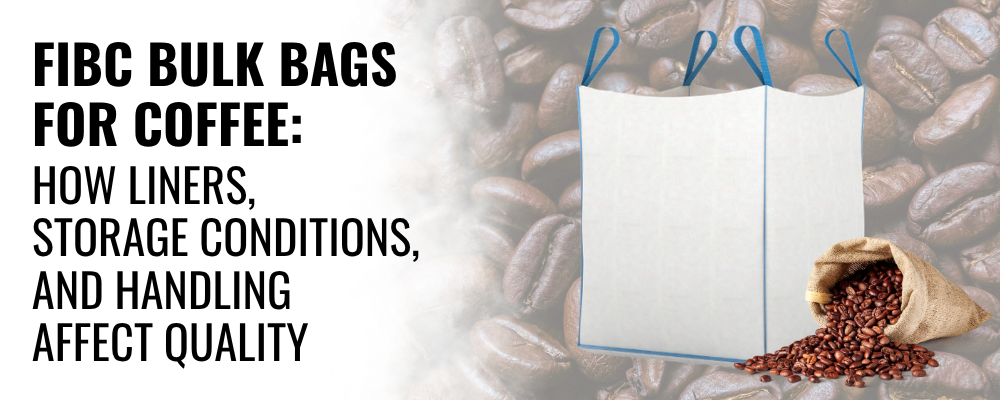
Is your packaging protecting your brew? Learn how FIBC bulk bags and specialized liners preserve coffee bean quality from warehouse to roaster.
Coffee Bean storage depends on more than warehouse temperature and humidity. Packaging also affects how well beans hold moisture, reduce contamination risk, preserve aroma, and move through storage and transit without unnecessary handling issues.
For operations, engineering, and supply chain teams, FIBC bulk bags for coffee beans should be evaluated as part of the storage-control process. The bag, liner, filling method, discharge method, storage time, and compliance documentation all influence how the product performs before roasting.
## Why Coffee Bean Storage Conditions Matter
Coffee beans can be affected by the environment around them during storage and transportation. High humidity can cause beans to absorb moisture. Dry conditions can cause moisture loss and brittleness. Temperature swings can also contribute to condensation, especially during ocean freight, staging, or warehouse transfers.
These changes may not be visible right away, but they can affect roasting consistency, product stability, aroma retention, and quality control. Packaging cannot replace proper facility controls, but the right bag and liner combination can help reduce exposure during handling, storage, and transit. Coffee beans can be affected by the environment around them during storage and transportation. High humidity can cause beans to absorb moisture. Dry conditions can cause moisture loss and brittleness. Temperature swings can also contribute to condensation, especially during ocean freight, staging, or warehouse transfers.
These changes may not be visible right away, but they can affect roasting consistency, product stability, aroma retention, and quality control. Packaging cannot replace proper facility controls, but the right bag and liner combination can help reduce exposure during handling, storage, and transit.
## Bag and Liner Choice as a Storage Factor
When selecting FIBC bulk bags for coffee beans, the liner should be based on actual storage and shipping conditions. A regular FIBC bag without a liner may work for short-term storage in a controlled environment where humidity, contamination, and aroma loss are lower concerns. The advantage is a simpler bag structure. The limitation is less protection from moisture changes and outside exposure.
A food-grade plastic liner provides an added layer between the coffee and the surrounding environment. This can help reduce moisture exchange and contamination risk during normal storage or transport. However, plastic liners may not provide the same level of barrier protection as aluminum liner options.
An aluminum barrier liner may be better suited for longer storage periods, higher-humidity routes, or situations where aroma retention is a larger concern. These liners can help reduce exposure to moisture, oxygen, and aroma loss. The tradeoff is added cost, and they may not be necessary for every coffee application.
## How FIBC Bulk Bags Support Coffee Storage
FIBC bulk bags are used when coffee needs to be stored or moved in larger volumes. Compared with smaller packaging formats, they can reduce the number of transfers across filling, warehousing, shipping, and discharge.
Fewer handling steps can help reduce product damage, contamination risk, and exposure to uncontrolled dock or warehouse conditions. Bag construction also matters. The safe working load, lift loop design, top style, discharge style, closure method, and liner type should match the actual process used at the facility.
## BRC Food Compliance and Documentation
Because coffee is a food product, packaging should be reviewed for applicable BRC Food compliance, food-grade material requirements, traceability, and supplier documentation. This review should include both the outer bag and the liner, especially when the liner is the main material protecting the product.
---
Key Takeaway
FIBC bulk bags for coffee beans affect moisture control, handling efficiency, contamination prevention, aroma retention, and storage consistency. The best specification depends on facility conditions, transit route, storage length, liner needs, and compliance requirements. [Get a quote on bulk bags for coffee beans today. ](https://www.nationalbulkbag.com/#bagschatnow)
By [Laura Heinen](https://blog.nationalbulkbag.com/author/laura-heinen)
June 04, 2026
[0 Comments](https://blog.nationalbulkbag.com/fibc-bulk-bags-for-coffee-beans-how-liners-storage-conditions-and-handling-affect-quality#comments-listing)
#### Share This Story, Choose Your Platform!
- [Tweet](https://twitter.com/share)
#### About the Author: [Laura Heinen](https://blog.nationalbulkbag.com/author/laura-heinen)
Laura Heinen is an FIBC expert and a recognized #BagLady in the industrial bag industry. With years of hands-on experience, Laura brings a practical, customer-focused perspective to bulk packaging, helping customers find the right bag, application, and solution for their operation. Known for her straight-shooting approach and deep industry knowledge, Laura believes the best packaging solutions are the ones that work—not just the ones that look good on paper. When she’s not talking FIBCs, you’ll probably find her talking packaging, solving customer challenges, and continuing to live up to her reputation as the #BagLady.
Search
### Blog Categories
- [Bulk Bags (62)](https://blog.nationalbulkbag.com/topic/bulk-bags)
- [Bulk Bag Construction (27)](https://blog.nationalbulkbag.com/topic/bulk-bag-construction)
- [Bulk Bag Industries (21)](https://blog.nationalbulkbag.com/topic/bulk-bag-industries)
- [Food Grade Bulk Bags (18)](https://blog.nationalbulkbag.com/topic/food-grade-bulk-bags)
- [Produce Packaging (14)](https://blog.nationalbulkbag.com/topic/produce-packaging)
- [Bulk Bag Safety (11)](https://blog.nationalbulkbag.com/topic/bulk-bag-safety)
- [Bulk Bag Liners (8)](https://blog.nationalbulkbag.com/topic/bulk-bag-liners)
- [Dumpster Bag (6)](https://blog.nationalbulkbag.com/topic/dumpster-bag)
- [UN Certified Bulk Bags (5)](https://blog.nationalbulkbag.com/topic/un-certified-bulk-bags)
- [Pharmaceutical Bulk Bags (2)](https://blog.nationalbulkbag.com/topic/pharmaceutical-bulk-bags)
- [Agriculture Packaging Companies (1)](https://blog.nationalbulkbag.com/topic/agriculture-packaging-companies)
- [Burlap Bags (1)](https://blog.nationalbulkbag.com/topic/burlap-bags)
- [Grinding Media (1)](https://blog.nationalbulkbag.com/topic/grinding-media)
- [firewood bags (1)](https://blog.nationalbulkbag.com/topic/firewood-bags)
#### Browse our 50+ in-stock bulk bags
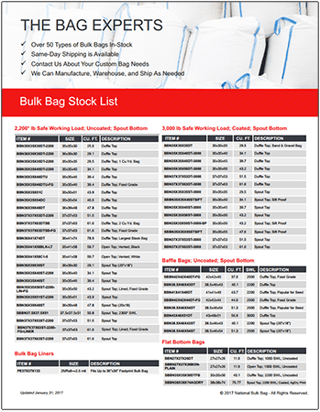
We stock one of the largest FIBC Bulk Bag inventories in the United States. Whether you are packing chemicals, food, minerals, resin, sand, soil or any dry flow-able product, we stock or can manufacture a bag to meet your requirements.
### Subscribe to our blog updates

**National Bulk Bag** has over 75 different types of FIBCs in stock and a team of experts that are ready to help.
### Secondary Navigation
- [Blog](https://blog.nationalbulkbag.com/)
- [Privacy Policy](http://www.nationalbulkbag.com/privacy-policy/)
- [FAQ](http://www.nationalbulkbag.com/faq/)
- [Custom Bags](http://www.nationalbulkbag.com/custom-bulk-bag-design/)
- [Get Quote](https://offers.nationalbulkbag.com/get-a-free-bulk-bag-quote)
- [Industries](http://www.nationalbulkbag.com/bulk-bag-industries/)
- [In-Stock Bags](http://www.nationalbulkbag.com/fibc-bulk-bags/)
- [Why NBB?](http://www.nationalbulkbag.com/why-work-with-national-bulk-bag/)
- [Meet NBB](http://www.nationalbulkbag.com/about-national-bulk-bag/meet-national-bulk-bag/)
- [Bulk Bag Types](http://www.nationalbulkbag.com/types-of-fibc-bulk-bags-a-b-c-d-explained/)
### AN AFFILIATE OF
[](https://www.rapidpackaging.com/)
### CONTACT US
Toll Free: 1-888-237-4224
Fax: 1-888-237-3722
Email: [info@nationalbulkbag.com](mailto:info@nationalbulkbag.com?Subject=National%20Bulk%20Bag%20Inquiry)
Copyright © 2018 National Bulk Bag | All rights reserved
Powered by [Digital 1](http://www.digital1ne.com)
-
-
-
-